Quickstart

This 5-minute tutorial gives a first impression of agile generative programming with the Wurbelizer. You will build a small wurblet that generates the code for a data transfer object (DTO) and let the wurbler weave it into a hand-written source file.
The complete, runnable sources are available at github.com/harrharr/wurbelizer-tutorial.
The tutorial is written against
wurbelizer.version25.7.0.0(JDK 25, Maven >= 3.9.10). The runnable reference sources on GitHub still pin older versions; the steps are identical — just the version numbers below differ.
Prerequisites
- JDK 25+ and Maven 3.9.10+ on your
PATH. Check withmvn --version. - Any modern Java IDE or plain command-line tools. (Eclipse cannot fold the generated blocks, but everything else works.)
The project is a multi-module Maven build with two modules: one that creates the wurblet, and one that uses it to generate code.
Parent pom.xml
<project ...>
  <modelVersion>4.0.0</modelVersion>

  <groupId>com.example</groupId>
  <artifactId>wurbelizer-tutorial</artifactId>
  <version>1.0-SNAPSHOT</version>
  <packaging>pom</packaging>

  <properties>
    <project.build.sourceEncoding>UTF-8</project.build.sourceEncoding>
    <project.build.resourceEncoding>UTF-8</project.build.resourceEncoding>
    <wurbelizer.version>25.7.0.0</wurbelizer.version>
  </properties>

  <modules>
    <module>wurblets</module>
    <module>sample</module>
  </modules>

  <build>
    <pluginManagement>
      <plugins>
        <plugin>
          <groupId>org.wurbelizer</groupId>
          <artifactId>wurbelizer-maven-plugin</artifactId>
          <version>${wurbelizer.version}</version>
        </plugin>
        <plugin>
          <groupId>org.apache.maven.plugins</groupId>
          <artifactId>maven-compiler-plugin</artifactId>
          <version>3.13.0</version>
          <configuration>
            <release>25</release>
          </configuration>
        </plugin>
      </plugins>
    </pluginManagement>
  </build>
</project>
1. The first wurblet
The wurblets module holds the generator. Its pom.xml depends on the Wurbelizer and
runs the wurbile goal, which translates the wurblet source code into compilable Java
plus a resource file holding the fixed strings:
<project ...>
  <parent>
    <groupId>com.example</groupId>
    <artifactId>wurbelizer-tutorial</artifactId>
    <version>1.0-SNAPSHOT</version>
  </parent>

  <artifactId>wurblets</artifactId>

  <dependencies>
    <dependency>
      <groupId>org.wurbelizer</groupId>
      <artifactId>wurbelizer</artifactId>
      <version>${wurbelizer.version}</version>
    </dependency>
  </dependencies>

  <build>
    <plugins>
      <plugin>
        <groupId>org.wurbelizer</groupId>
        <artifactId>wurbelizer-maven-plugin</artifactId>
        <executions>
          <execution>
            <goals>
              <goal>wurbile</goal>
            </goals>
          </execution>
        </executions>
      </plugin>
    </plugins>
  </build>
</project>
The model
The DTO model is a simple line-based format. Each non-empty, non-# line describes one
property as <java-type> <name> [comment...]:
The wurblet base class
The logic that parses the model is plain Java. A wurblet is any class implementing
org.wurbelizer.wurblet.Wurblet; the abstract base classes AbstractWurblet and
AbstractJavaWurblet make this easy. Put DTOWurblet.java in
wurblets/src/main/java/com/example/wurblets/:
package com.example.wurblets;

import org.wurbelizer.wurbel.WurbelException;
import org.wurbelizer.wurbel.WurbelHelper;
import org.wurbelizer.wurblet.AbstractJavaWurblet;

import java.io.BufferedReader;
import java.io.IOException;
import java.util.ArrayList;
import java.util.List;
import java.util.StringTokenizer;

/**
 * Base class for the {@code @DTO}-wurblet.
 * <p>
 * Parses wurblet args and the model.
 */
public class DTOWurblet extends AbstractJavaWurblet {

  /** DTO property. */
  protected class Property {

    private final String type;        // the java type
    private final String name;        // the property name
    private final String comment;     // the comment

    public Property(String type, String name, String comment) {
      this.type = type;
      this.name = name;
      this.comment = comment == null || comment.isEmpty() ? "the " + name + " property" : comment.trim();
    }

    public String getType()       { return type; }
    public String getName()       { return name; }
    public String getComment()    { return comment; }
    public String getGetterName() { return ("boolean".equals(type) ? "is" : "get") + firstToUpper(name); }
    public String getSetterName() { return "set" + firstToUpper(name); }
  }

  protected String filename;            // here-doc holding the model (given as "@> .$filename")
  protected List<Property> properties;  // the DTO properties

  @Override
  public void run() throws WurbelException {
    super.run();

    if (getContainer().getArgs().length == 0) {
      throw new WurbelException("usage: @wurblet <guardname> DTO <filename>");
    }
    filename = getContainer().getArgs()[0];

    properties = new ArrayList<>();

    try (BufferedReader reader = new BufferedReader(WurbelHelper.openReader(filename))) {
      String line;
      while ((line = reader.readLine()) != null) {
        line = line.trim();
        if (!line.isEmpty() && !line.startsWith("#")) {
          StringTokenizer stok = new StringTokenizer(line);
          String type = null;
          String name = null;
          StringBuilder comment = new StringBuilder();
          while (stok.hasMoreTokens()) {
            String token = stok.nextToken();
            if (type == null)      { type = token; }
            else if (name == null) { name = token; }
            else {
              if (comment.length() > 0) { comment.append(' '); }
              comment.append(token);
            }
          }
          if (type == null || name == null) {
            throw new WurbelException("property line too short: '" + line + "'");
          }
          properties.add(new Property(type, name, comment.toString()));
        }
      }
    }
    catch (IOException ex) {
      throw new WurbelException("reading model " + filename + " failed", ex);
    }
  }

  private String firstToUpper(String str) {
    return str.substring(0, 1).toUpperCase() + str.substring(1);
  }
}
The template
The .wrbl file is where output text and Java logic meet. Recall the level-switching
markers: @[ … ]@ switches to the wurblet (Java) level, and @( … )@ embeds a
wurblet-level expression back into the output. Put DTO.wrbl in
wurblets/src/main/wurblets/com/example/wurblets/:
@{package com.example.wurblets}@
@{import java.util.*}@
@{import java.io.*}@
@{import org.wurbelizer.wurbel.*}@
@{import org.wurbelizer.wurblet.*}@
@{import org.wurbelizer.misc.*}@
@{extends DTOWurblet}@
@{args}@
@[
  private void wurbel() throws WurbelException {

    // create declarations
    for (Property property: properties) {
]@
  private final @(property.getType())@ @(property.getName())@;  // @(property.getComment())@
@[
    }
]@

  /**
   * Creates a @(getClassName())@.
   *
@[
    // create constructor
    StringBuilder args = new StringBuilder();
    for (Property property: properties) {
      if (args.length() > 0) {
        args.append(", ");
      }
      args.append(property.getType()).append(' ').append(property.getName());
]@
   * \@param @(property.getName())@ @(property.getComment())@
@[
    }
]@
   */
  public @(getClassName())@(@(args)@) {
@[
    for (Property property: properties) {
]@
    this.@(property.getName())@ = @(property.getName())@;
@[
    }
]@
  }
@[
    // create getter
    for (Property property: properties) {
]@

  /**
   * Gets @(property.getComment())@.
   *
   * \@return @(property.getComment())@
   */
  public @(property.getType())@ @(property.getGetterName())@() {
    return @(property.getName())@;
  }
@[
    }
  }
]@
Running mvn clean install in the parent directory now invokes the wurbiler (the
wurblet compiler), compiles the generated Java, and packages the wurblets jar.
2. Generate code
The sample module uses the wurblet. Its pom.xml runs the wurbel goal, loads the
wurblets from the wurblets artifact built above, and prepends the package
com.example.wurblets so a simple wurblet name like DTO resolves:
<project ...>
  <parent>
    <groupId>com.example</groupId>
    <artifactId>wurbelizer-tutorial</artifactId>
    <version>1.0-SNAPSHOT</version>
  </parent>

  <artifactId>sample</artifactId>

  <build>
    <plugins>
      <plugin>
        <groupId>org.wurbelizer</groupId>
        <artifactId>wurbelizer-maven-plugin</artifactId>
        <executions>
          <execution>
            <goals>
              <goal>wurbel</goal>
            </goals>
          </execution>
        </executions>
        <configuration>
          <wurbletDependencies>
            <wurbletDependency>
              <groupId>${project.groupId}</groupId>
              <artifactId>wurblets</artifactId>
              <version>${project.version}</version>
            </wurbletDependency>
          </wurbletDependencies>
          <wurbletPaths>
            <wurbletPath>com.example.wurblets</wurbletPath>
          </wurbletPaths>
        </configuration>
      </plugin>
    </plugins>
  </build>
</project>
The source file
Create SampleDTO.java in sample/src/main/java/com/example/. It carries the model as
a here-document in a leading comment (@> … @<) and a wurblet anchor marking where
the generated code belongs:
package com.example;

/*
 * @> .$filename
 * String    name       the name
 * long      id         the unique ID
 * boolean   enabled    whether enabled or not
 * @<
 */

/**
 * A very simple data transfer object.
 */
public class SampleDTO {

  // @wurblet dto DTO .$filename

}
Run it
Run mvn clean install again. The wurbler reads the anchor, runs the DTO wurblet
against the .$filename model, and writes the generated code straight into a guarded
block in SampleDTO.java:
public class SampleDTO {

  // @wurblet dto DTO .$filename

  //<editor-fold desc="code 'dto' generated by wurblet DTO">//GEN-BEGIN:dto

  private final String name;  // the name
  private final long id;  // the unique ID
  private final boolean enabled;  // whether enabled or not

  /**
   * Creates a SampleDTO.
   *
   * @param name the name
   * @param id the unique ID
   * @param enabled whether enabled or not
   */
  public SampleDTO(String name, long id, boolean enabled) {
    this.name = name;
    this.id = id;
    this.enabled = enabled;
  }

  /**
   * Gets the name.
   *
   * @return the name
   */
  public String getName() {
    return name;
  }

  /**
   * Gets the unique ID.
   *
   * @return the unique ID
   */
  public long getId() {
    return id;
  }

  /**
   * Gets whether enabled or not.
   *
   * @return whether enabled or not
   */
  public boolean isEnabled() {
    return enabled;
  }

  //</editor-fold>//GEN-END:dto

}
Take a look at the file in your IDE and see what happened:
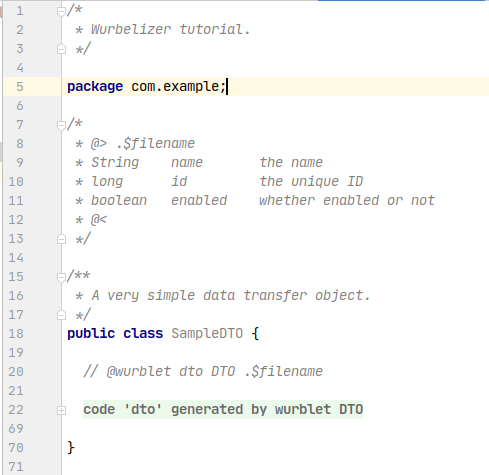
In the IDE the block appears collapsed. You can expand it, but you should not edit inside it: the region belongs to the wurblet and manual changes are overwritten on the next build. Change the model and re-run — the generated code follows.