
The Wurbelizer is a code generator, written in Java, using Java as its template language and embedded within source files, usually Java. Rather than creating entire source files, it modifies well-defined regions of code. It is lightweight, easy to integrate, easy to learn — and yet flexible and powerful.
This document covers the usage and integration. New here? Start with the 5-minute quickstart, or visit the Java site docs as a reference.
Key Features
- Java is the meta language. The logic that decides what to generate is written
in ordinary Java, not in a bespoke template language. A
.wrblfile is just output text with Java escaped into it via the level-switching markers (@[ … ]@for statements,@( … )@for expressions), and the wurbiler translates that template into a real Java class that is compiled and run. The practical consequences: - No second language to learn. Loops, conditionals, method calls and types are plain Java — if you know the target language, you already know the meta language.
- The full Java ecosystem is available at generation time. Wurblets can use any library on the classpath to read models (databases, XML/JSON, annotations, reflection) and drive the output.
- Full tooling support. Because wurblets compile to normal classes, you get the compiler's type checking, your IDE's completion and debugging, and ordinary stack traces when something goes wrong — no opaque template engine in between.
-
One language across all three levels. The generator logic, the generated code, and the application being modified are all Java, so there is no impedance mismatch between writing a generator and reading its result.
-
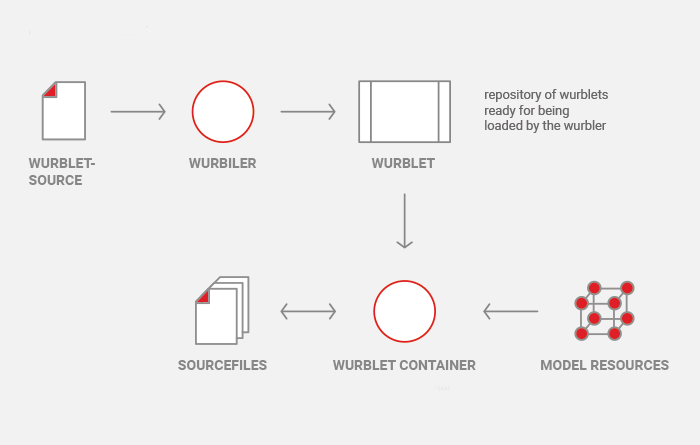
Three code levels instead of two. Unlike typical generators that only know a generator level and a generated-code level, the Wurbelizer adds a third: the source level. A wurblet's own source mixes the wurblet level (the generator's Java logic) with the output level (the text it emits), while the source level is your application's code that the wurbler reads and rewrites. This separation keeps templates expressive without ever leaving plain Java.
-
In-place generation into guarded blocks. Generated code does not live in separate, throw-away files. The wurbler inserts and updates it directly inside your hand-written source files, confined to clearly delimited guarded blocks. You edit around the generated regions freely; regeneration only touches what it owns, so machine-written and human-written code coexist in the same file.
-
Iterative generation until stable. The wurbler re-runs the wurblets until the output stops changing, because generated code can itself contain new wurblet anchors. This makes multi-stage and self-referential generation possible, and a file is only written back to disk when something actually changed.
-
Lightweight and easy to integrate. A small, LGPL-2.1 library that is quick to learn yet flexible and powerful. It drops into existing builds through first-class Maven and Ant integration, or a console runner, with no heavyweight runtime or framework to adopt.
-
Pluggable guard types and source-level tooling. Guarded blocks are recognized through swappable guard types — NetBeans/IntelliJ, Eclipse and Visual Studio styles ship in the box, and custom ones register via the Java service-provider mechanism. Combined with here-documents and variables at the source level, the same wurblet adapts across IDEs and project conventions.
Used in the Wild: Tentackle
The Wurbelizer did not start out as a standalone project. It emerged from practical development needs, originally created alongside the Java framework Tentackle, which heavily relies on generative programming, and was later opened up for anyone to use.
Tentackle remains a real-world, large-scale user of the Wurbelizer. It is a Java framework for building multi-tier enterprise applications around Persistent Domain Objects (PDOs), where a single domain model spans everything from the database to the desktop client.
Tentackle keeps that model as the single source of truth and lets the Wurbelizer turn it into code at build time. The model lives in the PDO interfaces, and wurblets read it to generate the persistence layer, the DDL and the database migrations directly into the project's own sources. Because the generated code is merged into guarded blocks of hand-written classes, application developers extend the PDOs freely while regeneration keeps the boilerplate in sync — a concrete demonstration of the model-driven, in-place generation the Wurbelizer is designed for.
Terms and Definitions
- wurbelizer: the code generator project as a whole.
- wurbiler: translates the template source code into Java code and serialized text files.
- wurbler: parses the application's source files and invokes the wurblets to insert or update generated code in the source files within well-defined regions.
- wurblet: a code generator that is executed by the wurbler.
- guarded block: a well-defined region within a source file, generated by a wurblet.
- guard type: a pattern describing the bounds of a guarded block.
- wurblet anchor: a Java comment that describes a guarded block by its name, the wurblet generating its contents and optional arguments (usually to locate some model or other parameters further specifying the code generation process).
- wurbile: verb describing the translation and compilation of a wurblet
- wurbel: verb describing the code generation